


This is the true story of how a missing comma taught me a lesson in letting go and accepting things I cannot change…
At 5am this morning, I found myself hunched over my phone, eyebrows knitted, muttering at the screen about comma usage. Not one of my more glamorous moments.
What started as a simple question — “Why is the first comma in a non-essential clause always missing?” — spiralled into a full-scale mission to discover how to retrain AI models single-handedly. Surely, I thought, if I just explain the rule clearly enough, or feed it enough examples, I could help the entire digital world stop doing something that is objectively, undeniably wrong.
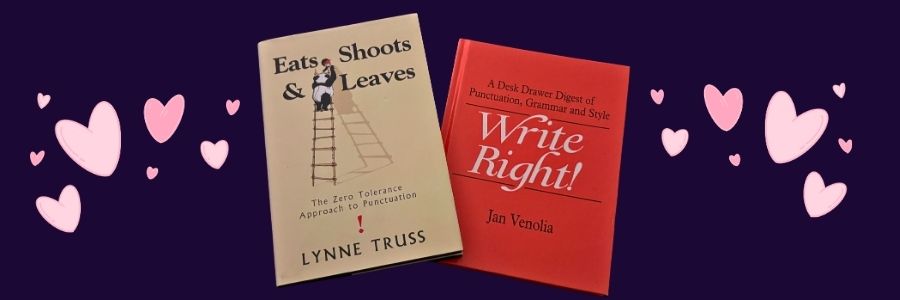
Because it is wrong – and I know these things because I own these books, and more besides (yes, these really are my books!)
If a clause is non-essential, it needs two commas.
One before.
One after.
Like bookends.
Like a pair of shoes.
Like any other matching set, you wouldn’t wear only half of it.
But there it was again — the missing first comma — popping up in AI-generated text, published books, online articles, and emails. Once you know the rule, you can’t avoid seeing it. And every time it appears, something inside me jolts. It is a small jarring, but a real one. A little spark of “But that’s not right. Why can’t we just fix it?”
The truth, of course, surfaced after an hour of bleary-eyed research and mild indignation: I cannot fix it. Not on my own. And apparently not at all.
And that was when the actual lesson emerged.
When the small things aren’t small
It’s almost comical that the catalyst for this reflection was a comma — which often feels like the most unassuming and gentle punctuation mark of them all. But small things often give away bigger truths.
Why does a missing comma bother me so much?
Because it represents:
- a lack of clarity,
- a breach in flow,
- an interruption to correctness, and
- a tiny chaotic ripple in a world already full of them.
That missing comma felt symbolic. If I can’t even rely on punctuation rules to behave themselves, what hope is there for the bigger stuff?
Where else in life do I crave tidy boundaries, reliable rules, and structures that simply make sense?
Where else do I bristle when something doesn’t line up with how I expect things to be??
Where else do I find myself trying to fix every misalignment — even when it’s outside my control?
The Serenity Prayer for punctuation
There’s a well-known line often used in coaching and therapy, commonly attributed to theologian Reinhold Niebuhr in the 1940s and later adopted widely by 12-step recovery communities:
“Grant me the serenity to accept the things I cannot change,
the courage to change the things I can,
and the wisdom to know the difference.”
This morning, at 5am, I realised I’d been trying to reverse the order:
- Courage to change a global linguistic trend?
- Wisdom… questionable.
- Serenity? Nowhere in sight.
I was deep in the non-serenity zone over a comma.
But this is exactly how the mind works. When we care about accuracy, clarity, or doing things properly, our warning bells ring loudest around the very things we cannot control.
It’s not really about punctuation.
It’s about acceptance.
It’s about surrendering to the reality that correctness isn’t always universal.
And that the world does not rearrange itself to match our internal sense of “how things should be.”
Letting go – not of standards, but of ownership
A key shift emerged for me: I don’t need to abandon the correct rule or lower my standards. I also don’t have to pretend the missing comma doesn’t bother me.
Acceptance doesn’t mean agreement.
Acceptance means recognising what is mine to influence and what is simply not mine.
I can control:
- the clarity of my own writing,
- the precision I teach my clients,
- the quality of the content I produce, and
- the care I put into communication.
I cannot control:
- global writing habits,
- the shortcuts of modern publishing,
- the quirks of AI training data, or
- how anyone else chooses to punctuate anything, ever.
And there is freedom in that.
Because the moment we stop trying to single-handedly reshape the world to match our preference for order and correctness, we free up energy for the things that truly matter.
When acceptance becomes a strength
Accepting “the missing first comma is here to stay, regardless of it being incorrect” wasn’t a defeat.
It was a boundary.
A reminder that:
- not everything needs to be fixed,
- not everything can be fixed, and
- not everything is mine to fix
In coaching terms, this is powerful self-awareness.
We often spend so much energy fighting small battles that distract from the real work: living in alignment with our values, choosing where our attention goes, and letting go of what drains us.
Sometimes the thing we need to accept isn’t monumental.
Sometimes it’s as tiny as a comma.
But the lesson is the same size, no matter how small the trigger.

Final thoughts
I still shudder a little when I see only one comma where there should be two. That won’t change.
But what has changed is this:
- I’m learning to notice the jolt… and let it pass.
- I see correctness as my preference, not my responsibility.
- I accept that clarity is something I can embody, not enforce.
Most importantly, I’m learning that, if something can wake me up at 5am, it probably has more to teach me than I realised.
If you’d like support exploring your own “missing comma moments” – those tiny but telling frustrations that reveal bigger truths – that’s exactly the kind of work coaching is made for.
Sometimes the smallest irritation is the doorway to the greatest insight.
If you want to explore more about accepting things you cannot change, why not book a free discovery call with me?
Further Reading & Recommended Resources
Eats, Shoots & Leaves – Lynne Truss
A witty, irreverent ode to punctuation — ideal for anyone who feels personally offended by misplaced commas and wants to laugh about it rather than lose sleep at 5am.
The Subtle Art of Not Giving a Fck – Mark Manson*
A sharp, humorous reminder that we can’t care deeply about every tiny frustration. A brilliant companion for letting go of battles we cannot win (especially grammatical ones).
The Happiness Trap – Dr. Russ Harris
A clear, practical guide to acceptance and defusion — helpful for noticing irritation without fighting it, whether it’s life’s challenges or rogue commas.
The Gifts of Imperfection – Brené Brown
Encourages releasing perfectionism and embracing wholehearted living — a gentle nudge to stop trying to fix everything and focus on what truly matters.
Essentialism: The Disciplined Pursuit of Less – Greg McKeown
A straightforward invitation to conserve energy for what you can influence, and gracefully release the rest. Perfect for anyone prone to going into battle with punctuation trends.


